
No Added Sugar: What It Really Means on a Toddler Snack Label
Stand in the toddler snack aisle for five minutes and you'll see the same three words on half the boxes: no added sugar. Sometimes it's true in the way you'd hope. Sometimes it's true on a technicality. And sometimes the claim isn't there at all because the snack couldn't survive it.
We've spent more time squinting at tiny nutrition panels than we'd like to admit — it's half the reason we started making our own toddler pancakes. Here's what we've learned about what these labels actually mean, so you can get through the aisle faster.
Added sugar vs. natural sugar, in plain English
All sugar is sugar to your taste buds, but where it comes from matters:
- Natural sugars are the ones already inside whole foods — the fructose in a banana, the lactose in milk. They come packaged with fiber, protein, vitamins, and water, which slows everything down and adds real nutrition.
- Added sugars are anything poured in during processing to make a food sweeter: cane sugar, honey, maple syrup, brown rice syrup, agave — and yes, fruit juice concentrate (more on that trick below).
A banana and a spoonful of sugar are not the same thing, even if a gram counter says otherwise. The banana brings fiber and potassium along for the ride; the spoonful brings nothing but sweet.
What the experts generally suggest
Two widely cited guidelines are worth knowing as a general reference (not medical advice — your pediatrician knows your kid):
- Under age 2: avoid added sugars entirely. This appears in the American Heart Association's recommendations and the U.S. Dietary Guidelines. The reasoning is simple — little ones have small appetites, and every bite of added sugar displaces a bite of something more nutritious.
- Ages 2 and up: less than 25 grams (about 6 teaspoons) of added sugar per day, per the AHA's guidance for children.
For context, a single kids' yogurt tube or a small pouch of "fruit snacks" can burn through a big chunk of that daily budget before lunch.
How to actually read the label
Skip the front of the box — that's the marketing department's real estate. Flip it over:
- Find the "Added Sugars" line. U.S. nutrition panels are required to list added sugars separately, indented under "Total Sugars." This line is your friend. "Total Sugars 8g" with "Added Sugars 0g" means all the sweetness came from ingredients like fruit or milk.
- Read the ingredient list, in order. Ingredients are listed by weight. If any form of sugar shows up in the first three ingredients, that snack is dessert wearing a costume.
- Learn sugar's aliases. Cane juice, evaporated cane syrup, rice syrup, dextrose, maltose, honey, agave nectar, molasses, fruit juice concentrate — there are dozens. If it ends in "-ose" or "syrup," it counts.
The marketing traps to watch for
- "Fruit juice concentrate." This is the big one. Juice concentrate is fruit with the fiber stripped out and the sugar concentrated — nutritionally it behaves like added sugar, and the FDA counts it as one when it's used as a sweetener. "Sweetened only with fruit juice" sounds wholesome; it usually isn't.
- "No refined sugar." Honey, maple syrup, and agave are less refined, but your toddler's body treats them like sugar all the same. Under 2, they're all in the "avoid" bucket (and honey is off-limits under 12 months regardless).
- "Made with real fruit." This can mean a whisper of fruit powder in an otherwise sweet cookie. Check where the fruit sits in the ingredient list.
- Baby-aisle halo. A cartoon bear and the word "toddler" on the front don't change what's on the back. Some toddler-branded snacks carry more sugar per gram than regular grocery items.
What to look for instead
Our shorthand after years of label-reading:
- "Added Sugars: 0g" on the panel — the claim that's actually regulated.
- Whole foods doing the sweetening — real banana, apple, dates as whole fruit — listed high in the ingredients.
- A short list you can read aloud without slowing down. Oats, banana, eggs, blueberries: great. Fourteen ingredients you'd need a lab coat to pronounce: pass.
That's the standard we hold our own pancakes to — sweetened by banana, nothing else — because it turns out toddlers don't need food to be candy-sweet. They just need it to taste good and be easy to hold.
The bottom line
You don't have to become a nutrition scientist to shop well for your toddler. One habit gets you 90% of the way: ignore the front, read the back. Find the Added Sugars line, scan the first three ingredients, and let the cartoon bear say whatever it wants.
This article is for informational purposes only and isn't medical advice. Always consult your pediatrician about your child's diet.
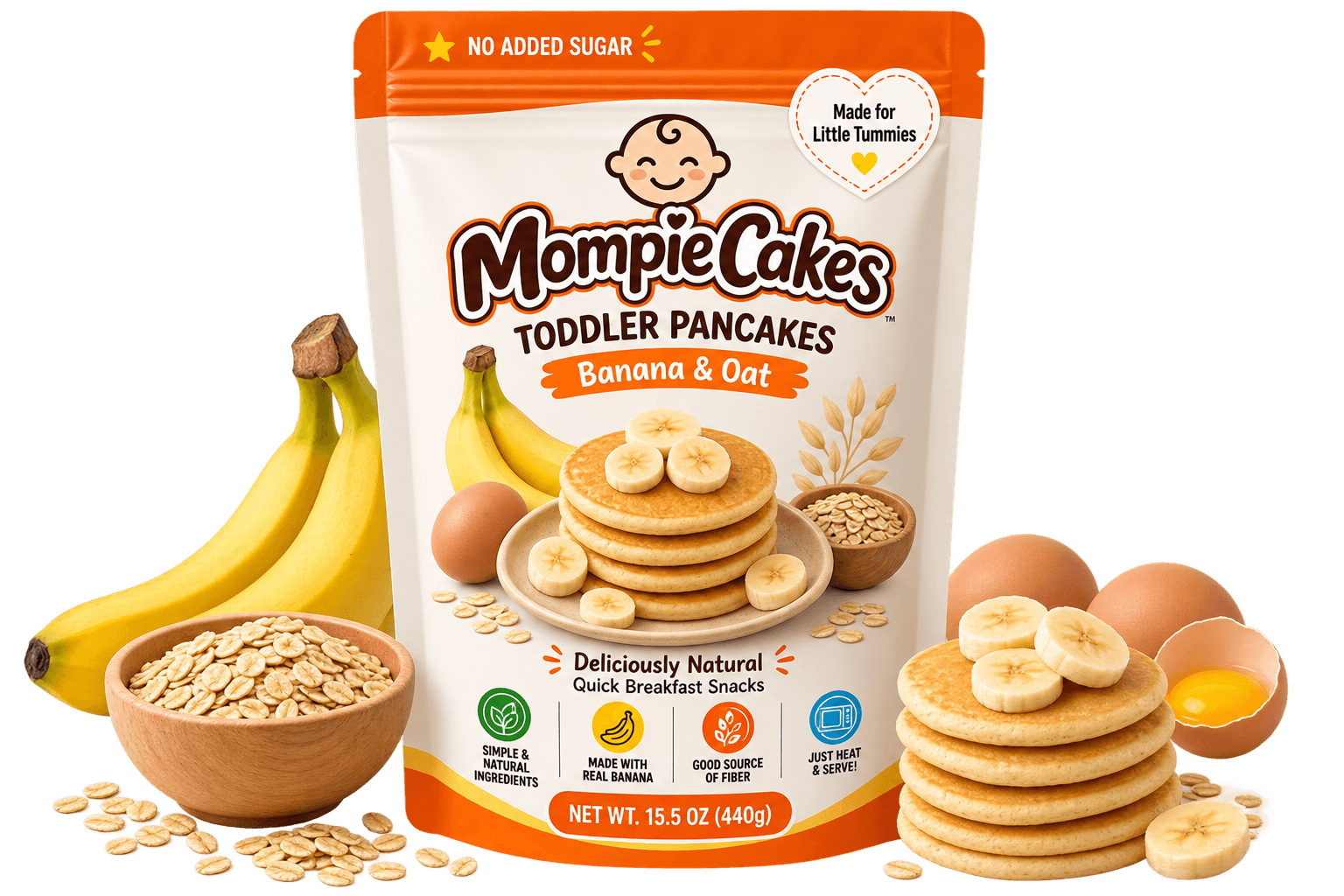
Try Mompie Cakes
Soft-baked banana & oat pancakes for ages 6 months – 3 years. No added sugar, ready in under a minute.
Shop Pancakes